

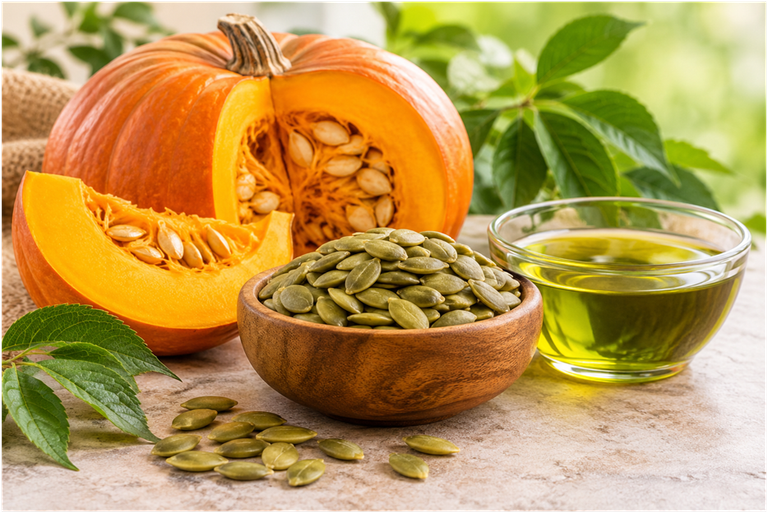
Prostate health becomes an increasingly important concern as men age. Benign prostatic hyperplasia (BPH), or non-cancerous enlargement of the prostate, can contribute to lower urinary tract symptoms such as a weak stream, difficulty starting urination, urgency and waking during the night to urinate. Pumpkin seeds and products made from them have attracted scientific interest as possible ways to support urinary health. Some supplements combine pumpkin seed extract with other botanical ingredients; one example is UROSTEROL by Pharmacom. Understanding the evidence requires distinguishing whole seeds, seed oil and concentrated extracts, because they are different preparations and have not been tested interchangeably.
Why Pumpkin Seeds Are Studied for Prostate Health
Pumpkin seeds (Cucurbita pepo) contain unsaturated fatty acids, phytosterols, protein, fibre and minerals. Phytosterols are plant compounds with a chemical structure resembling cholesterol. Researchers have explored whether compounds in pumpkin seeds may influence pathways involved in prostate growth, including those associated with dihydrotestosterone (DHT). DHT contributes to normal prostate development and is also involved in the enlargement seen in BPH. These proposed mechanisms are biologically interesting, but laboratory findings alone cannot prove that eating seeds or taking a supplement will improve symptoms in people.
Whole Pumpkin Seeds: Evidence from the GRANU Study
Whole seeds are a food rather than a concentrated preparation. They provide fibre, protein and a mixture of fats and plant compounds, and can be eaten raw or roasted as part of a balanced diet.
A major clinical investigation, the one-year German Research Activities on Natural Urologicals (GRANU) study, enrolled 1,431 men aged 50 to 80 with lower urinary tract symptoms suggestive of BPH. Participants were assigned to whole pumpkin seeds at 5 grams twice daily, pumpkin seed extract capsules at 500 milligrams twice daily, or placebo. After 12 months, the response rate was 58.5% in the whole-seed group and 47.3% with placebo. The extract arm did not differ significantly from placebo on the study’s primary response measure.
This study is particularly useful because it tested whole seeds and an extract separately. Its results should not be simplified into a claim that every pumpkin seed product has the same effect. The whole-seed finding was encouraging, but it does not establish pumpkin seeds as a treatment for BPH.
Pumpkin Seed Oil: A Different Preparation
Pumpkin seed oil is pressed or otherwise extracted from seeds. It is rich in oil-soluble components, including unsaturated fatty acids and phytosterols, but it does not provide the same amount of fibre or protein as whole seeds. Oil products also vary according to the seed variety and manufacturing process.
A 2021 single-blind randomized clinical trial published in BMC Urology compared pumpkin seed oil with tamsulosin in 73 men aged 50 or older with BPH. The pumpkin group received 360 milligrams of pumpkin seed oil twice daily, while the comparison group received 0.4 milligrams of tamsulosin each night. Both groups experienced improvements in symptom scores over three months, but symptom-score reductions were greater with tamsulosin at the one- and three-month assessments. The authors concluded that further studies were needed.
The preparation in this trial was specifically pumpkin seed oil in capsules. The results cannot automatically be applied to whole seeds or dry extracts, and the study does not show that oil is equivalent to prescription treatment.
Pumpkin Seed Extract: Concentrated Compounds
Extracts are made by processing seeds to concentrate selected constituents. Their composition depends on the plant variety, extraction solvent and manufacturing method. A dry or soft extract is therefore not simply the same thing as ground seeds, and different extracts may not have identical chemical profiles.
A 2022 meta-analysis in Phytotherapy Research pooled two randomized, placebo-controlled trials lasting 12 months. The active intervention was a specific pumpkin seed soft extract in capsules, taken at 500 milligrams twice daily. The extract was produced from a defined cultivar of Cucurbita pepo using an ethanol-based extraction process and contained characteristic Δ7-phytosterols. The pooled analysis reported improvements in lower urinary tract symptom scores and quality of life compared with placebo. Because the analysis concerned this particular soft extract, its findings should not be generalized to every pumpkin seed extract or to pumpkin seed oil.
In short, the clinical evidence concerns distinct forms: whole seeds in the GRANU study, oil in the 2021 trial, and a defined soft extract in the 2022 analysis. Dose, formulation and study design all matter.
What Does the Overall Evidence Show?
A systematic review and meta-analysis published in 2026 assessed eight randomized trials involving 2,170 men. It found a small reduction in symptom scores with pumpkin seed preparations compared with placebo at three months, but not at six months. It found no statistically significant difference from alpha-blockers, but the authors emphasized that equivalence had not been established. They rated the certainty of evidence as low to very low. Taken together, the research suggests possible modest support for some urinary symptoms, not a proven treatment for prostate enlargement.
UROSTEROL® by Pharmacom: Composition and Evidence
UROSTEROL® is an example of a multi-ingredient food supplement containing pumpkin seed extract. The manufacturer’s product information describes a formulation combining pumpkin seed ingredients, including dry pumpkin seed extract, with goldenrod and European aspen extracts, as well as added phytosterols. These are the product’s stated components; the formulation should not be confused with the single-ingredient preparations tested in the clinical studies described above.
This distinction is important. Research on whole pumpkin seeds, pumpkin seed oil or a specific standardized pumpkin seed extract is evidence about those study preparations, not proof that the finished UROSTEROL® product has the same effects. The complete product would need to be tested in well-designed clinical trials to establish its own safety and effectiveness. The product name above links directly to the manufacturer’s product page.
Practical Considerations and When to Seek Advice
Pumpkin seeds can be included in a varied diet, but supplements should not replace medical assessment or prescribed treatment. Urinary symptoms can have several causes, including BPH, infection and other urological conditions. Men with persistent symptoms should speak with a healthcare professional rather than self-diagnosing. Sudden inability to urinate, blood in the urine, fever with urinary symptoms or severe pain warrants prompt medical attention.
Conclusion
Pumpkin seeds are nutritious, and research into whole seeds, pumpkin seed oil and concentrated extracts has produced some promising but limited findings for lower urinary tract symptoms associated with BPH. These preparations are not interchangeable, and the exact form used in each study matters. UROSTEROL® by Pharmacom illustrates how pumpkin seed extract may be combined with other botanical ingredients in a food supplement, but evidence about individual ingredients should not be presented as clinical proof for the finished product. A balanced diet and appropriate medical care remain central to prostate health.
