

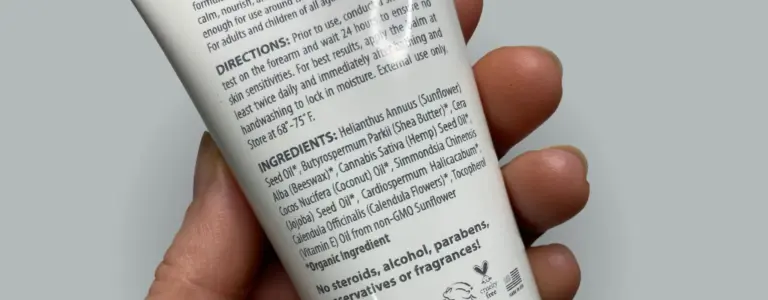
Why the Order of Ingredients Matters
Skincare labels list ingredients by concentration, from highest to lowest. The first five or six names on the list usually make up most of the product. Everything after water, glycerin, or a basic emollient is often present in small amounts, sometimes too small to do much.
This is the first thing worth checking before buying anything. A serum that lists “niacinamide” fourth is a different product from one that lists it twelfth, even if both put the word in large letters on the front of the bottle. Front-of-package claims are marketing. The ingredient list is the actual formula.
The Active Ingredients Worth Learning First
A handful of ingredients show up again and again, and knowing what they do removes most of the guesswork.
Retinoids (retinol, retinaldehyde, adapalene) speed up skin cell turnover. They help with fine lines and texture but can cause dryness or peeling at first, so they’re usually introduced slowly, a few nights a week.
AHAs and BHAs are exfoliating acids. Glycolic and lactic acid (AHAs) work on the skin’s surface. Salicylic acid (a BHA) gets into pores, which is why it shows up in products aimed at breakouts.
Vitamin C (often listed as ascorbic acid) is an antioxidant used mostly for brightening and protecting against environmental damage. It’s not an exfoliant and won’t replace sunscreen.
Niacinamide is a form of vitamin B3. It’s generally well tolerated and often included for redness and oil control.
Peptides are small proteins marketed for firmness. The research on them is still developing, and results tend to be modest compared to retinoids or acids.
None of these need to be used all at once. Layering several strong actives in one routine is a common reason skin gets irritated rather than improved.
Words That Sound Reassuring but Mean Less Than They Seem
Some label language is regulated and some isn’t.
“Fragrance-free” means no added fragrance ingredients. “Unscented” can still contain masking fragrance that cancels out a smell, which is not the same thing.
“Non-comedogenic” means a product is formulated to be less likely to clog pores, but it’s not a guaranteed promise for every skin type.
“Hypoallergenic” has no fixed legal definition in most places. It signals an attempt to reduce common allergens, not an absence of all possible reactions.
“Dermatologist tested” means a dermatologist was involved in testing at some point. It doesn’t say what the test measured or what the results were.
None of these phrases are meaningless, but they tell you less than the ingredient list does.
What SPF Numbers Tell You
SPF measures protection against UVB rays, the ones mainly responsible for sunburn. SPF 30 blocks about 97% of UVB rays, SPF 50 blocks about 98%. The jump from 30 to 50 is smaller than the numbers suggest.
SPF says nothing about UVA protection, which matters for long-term skin aging. In places that use it, “broad spectrum” on the label is the part that covers UVA. A high SPF without broad-spectrum coverage is only doing half the job.
Reapplication matters more than the number on the bottle. Most sunscreens lose effectiveness after a couple of hours outdoors, regardless of SPF.
Matching a Routine to What’s Happening With Your Skin
Ingredient labels become more important, not less, once someone starts any kind of professional skin treatment. Retinoids and exfoliating acids can make skin more sensitive, which changes what’s safe to use around an appointment. Clinics that offer laser or other skin procedures, such as Bellair Laser Clinic in Toronto, commonly talk clients through adjusting their home routine before and after a visit, since products that were fine on their own can react differently alongside a treatment plan.
This is a good reason to read labels before buying something new, rather than after a reaction shows up. A new retinol serum bought the same week as a skin treatment is a common and avoidable mismatch.
When to Bring the Bottle Instead of the Question
Describing a product from memory rarely gives a professional enough to go on. “It had vitamin C in it” could mean a dozen different formulations with very different strengths and pH levels.
Bringing the bottle, or a photo of the ingredient list, to a dermatologist or clinic consultation gets a faster and more accurate answer than trying to describe it out loud. It also makes it easier to catch overlapping actives across a routine, which is often where irritation starts.
Reading a label well doesn’t require memorizing chemistry. It mostly means slowing down enough to check what’s actually in the bottle before deciding what it’s supposed to do.
